
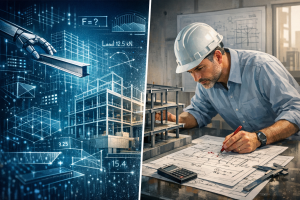
 Why Homeowners, Builders and Designers Should Be Wary of Relying on AI for Structural Design
Artificial intelligence can be a useful assistant. It can organise information, summarise standards, generate draft calculations and even suggest structural options in seconds. But when it comes to the safety and stability of a building, speed is not the same as competence. Resorting to AI instead of engaging a qualified structural engineer is not just a shortcut; it can be a serious risk to safety, compliance, cost and liability.
The Danger of Treating AI as a Substitute for Structural Engineering
Structural design is not simply a matter of plugging numbers into a formula. A safe design depends on judgement, inspection, assumptions, load paths, material behaviour, site conditions, code interpretation and professional accountability. AI tools do not visit the site, do not carry legal responsibility, do not understand hidden defects unless someone identifies them correctly, and can produce convincing but flawed outputs. In a safety-critical discipline, that combination is dangerous.
- AI can generate incorrect calculations while sounding confident.
- It may rely on incomplete, outdated or misinterpreted design standards.
- It cannot independently verify real-world conditions such as foundation quality, hidden deterioration, previous alterations or poor workmanship.
- It may miss the wider structural behaviour of a building, especially where load redistribution or stability is involved.
- It cannot accept professional liability if a design fails.
- Its output may look technical enough to create false confidence in unqualified users.
What a Structural Engineer Actually Brings to a Project
A qualified structural engineer does much more than perform calculations. They interpret the design brief, inspect existing conditions, identify risks, assess buildability, apply relevant codes, coordinate with architects and contractors, and exercise professional judgement where rules alone are not enough. In the UK context, structural design also sits within a wider framework of compliance, documentation and accountability. That human responsibility cannot be outsourced to a chatbot or automated tool.
Why This Matters to Different Audiences
Homeowners
For homeowners planning extensions, loft conversions, wall removals or renovations, AI may appear to offer a cheaper alternative to paying for professional advice. That can be a costly mistake. A beam size suggested by AI may ignore actual span conditions, bearing details, lateral restraint, foundation adequacy or the condition of the existing structure. If the advice is wrong, the consequences can include cracking, deflection, unsafe work, rejected building control submissions, expensive remedial work and difficulty selling or insuring the property later.
Developers and Builders
For developers and builders, the temptation is often speed and cost reduction. But using AI-generated structural design without proper engineering oversight can create far greater exposure. Errors can trigger delays, redesign, site rework, disputes, failed approvals, contractual claims and reputational damage. More importantly, if something goes wrong, responsibility does not disappear because a machine produced the output. In practice, liability still lands on the people and organisations who chose to rely on it.
Architects and Designers
Architects and designers may use AI to test ideas quickly, but structural feasibility is not something that should be assumed from an elegant concept or a plausible-looking set of calculations. A structural engineer helps turn design ambition into something safe, buildable and compliant. Without that collaboration, AI-assisted concepts can drift into schemes that are inefficient, non-compliant or fundamentally unsafe once real loads and site conditions are properly considered.
General Readers
The wider public is becoming used to AI answering questions with speed and fluency. The danger is that persuasive language can be mistaken for expertise. In structural engineering, a confident answer is not the same as a safe answer. Buildings depend on rigorous checking because failures can have serious human and financial consequences. This is one of the clearest examples of why professional expertise still matters.
Where AI Can Help — But Only as a Support Tool
This is not an argument against technology. AI can genuinely help structural professionals with repetitive tasks, early-stage option studies, document drafting, code research support and quality-checking workflows. Used properly, it may improve efficiency and free engineers to focus on higher-value judgement. The problem begins when people confuse assistance with authority. AI can support structural engineering; it should not replace the qualified engineer who is responsible for the work.
Final Thought
When people cut out structural engineers and rely on AI for design and calculations, they are not simply adopting a modern tool; they are removing a layer of professional judgement that exists for a reason. In a field where safety, legality and public trust matter, that is a gamble no responsible homeowner, developer, builder or designer should take. The smarter approach is not to ask whether AI can replace structural engineers, but how AI can be used responsibly under their oversight.


